

TEL
+886-222774593
FAX
+886-222774593

April 28, 2025 – Major Power Outage Incident in Portugal, Spain, and Western Europe.




Analysis of Power Outage Cause (Based on the 2025 Western Europe Blackout Case):
The root cause of this power outage was the failure of circuit breakers to disconnect and isolate the fault point within 1Hz (i.e., 0.0166 seconds) after the incident occurred. As a result, the three-phase current continued to flow into the fault location, causing an unbalanced overcurrent condition.
This unbalanced current prevented the first-layer instantaneous protection mechanisms—such as the 50 (instantaneous overcurrent) and 87 (differential protection)—from acting within 1Hz. The system thus missed the critical window for isolating the fault.
If the delay in disconnection exceeds 20Hz (approximately 0.33 seconds), the second-layer backup protection relays will be triggered. If that is still delayed, the third-layer defense system activates, including load shedding, grid separation (e.g., north-south islanding in Taiwan), or, in this case, a large-scale blackout across Western Europe.
Fortunately, in this incident, the system disconnected quickly enough to isolate the fault in time. Had it not, fault current would have penetrated deeper into the grid, damaging equipment, potentially leading to consequences far more severe than a simple outage—such as equipment meltdown, similar to the 2011 Fukushima nuclear disaster in Japan.
Conclusion:
To prevent catastrophic failure, fault isolation must occur within 0.0166 seconds (1Hz) after detection. Otherwise, the short-circuit fault point effectively becomes part of the system load and risks being destroyed. Thus, ultra-fast protection systems and precise digital technologies are essential for ensuring grid safety and equipment integrity in modern power systems.
 【CTS News Shocking Report】Electrocution Kills Over 100 Pigs! Can You Still Afford to Ignore Electrical Anomalies?
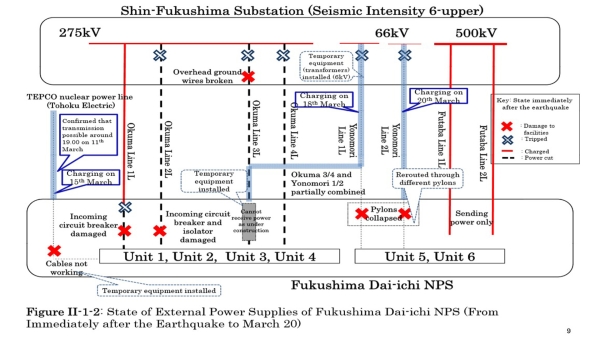 Fukushima Daiichi Nuclear Power Plant Accident – March 11, 2011
POWERED BY © 2024 WebG Design Studio